

POM Coated Bushings in 2026: DX Boundary Lubrication Demand Grows
The global polyoxymethylene (POM) market, valued at $4.36 billion in 2025, is projected to reach $7.20 billion by 2036 at a CAGR of 4.67%, with automotive applications as the primary driver, according to Chemanalyst data published April 2026. The composite bearing market, which includes POM-coated and PTFE-coated types, grows faster: Spherical Insights forecasts a climb from $5.77 billion in 2025 to $12.00 billion by 2035, at a CAGR of 7.6%. The global automotive bearing market itself was valued at $12.4 billion in 2020 and is expected to reach $18.31 billion by 2026 (CAGR 4.9%), according to Stratview Research, structurally driven by automakers' push to reduce vehicle weight for fuel efficiency and lower emissions. This weight-saving trend directly favors POM-coated sliding bearings over rolling-element alternatives.
POM-coated bushings, designated DX/SF-2 type, use a three-layer structure: a low-carbon steel backing for structural strength, a sintered bronze intermediate layer for thermal conductivity, and a POM (Polyoxymethylene) sliding surface. Key performance limits, per the GLT Bearings POM-MET® technical datasheet, include static load capacity ≤ 250 N/mm², dynamic load ≤ 140 N/mm², sliding speed ≤ 2.5 m/s, and a friction coefficient of 0.04–0.12. The maximum PV value is 2.8 N/mm²·m/s, a critical parameter for estimating service life. Temperature range: -40°C to +130°C. These bushings conform to DIN 1494 and ISO 3547 dimensional standards. Pre-pressed grease indents are a defining feature of DX-type bushings: they store initial lubricant and significantly reduce relubrication intervals, making DX suitable for boundary lubrication conditions, where full oil-film separation may not form during startup and low-speed operation.
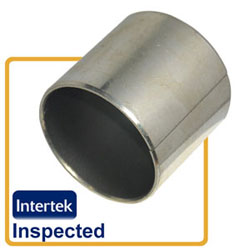
In practice, POM-coated bushings perform well in low-speed, high-load scenarios where rolling bearings cost more and take up more space. GGB, the originator of the DX® product line worldwide, lists DX bushings in shock absorbers, steering systems, transmissions, automotive HVAC compressors, and seat adjusters. Their January 2026 EV sell sheet highlights both POM and PTFE bushings gaining ground in EV drivetrain systems, where weight and space constraints are tighter than in ICE vehicles. For hydraulic cylinders, a market projected at $14.66 billion by 2026 (Fortune Business Insights), POM-coated bushings provide a cost-effective piston-guiding solution where full oil-film lubrication is the norm but emergency running capability is still required. Ahcell's DX series bushings (SF-2 equivalent) cover the same performance range, available in standard cylindrical bushes, flanged bushes, and thrust washers per DIN 1494 / ISO 3547 dimensions.
Chinese manufacturers now dominate POM bushing production. Metoree's April 2026 ranking of 12 manufacturers shows Chinese companies holding 88.9% of click share. Polyplastics Corporation's Duracon® remains the most widely used registered POM resin brand for bushings. As automotive shifts toward electrification, demand for boundary-lubricated bearings is set to accelerate: EV drivetrains, HVAC compressors, and seat mechanisms all need reliable, low-maintenance sliding solutions in compact packages. The 7.6% CAGR of the global composite bearing market reflects this shift.
- Pre:Graphite Bronze Yaw Bearings for Wind Turbines 2026 2026/4/30
- Next:Bimetal Bushing Market Surges at 6.1% CAGR Through 2033: 202 2026/4/28