

Bimetal Bushing Market Surges at 6.1% CAGR Through 2033: 2026 Capacity Expansions Signal Strong Demand for Steel-Back Copper Alloy Bearings
The global bimetal bearing market is on a firm upward trajectory, with a projected CAGR of 6.1% from 2026 through 2033 according to analysis by Reliable Market Size. Growth is anchored in rising demand from automotive powertrains, construction machinery, and the accelerating shift toward electric vehicle drivetrains — all segments where steel-back, copper-alloy-lined bushings deliver a combination of fatigue strength and embedability that monolithic bronze or polymer alternatives cannot match. In India, Bimetal Bearings Ltd. (BBL) reached a 52-week high of Rs 632.3 on April 22, 2026, reflecting investor confidence in the sector's expanding order books.
From a materials standpoint, the CuPb24Sn4 alloy (designated SAE-799 / JIS-LBC6) remains the workhorse for engine and transmission bushings. Under oil lubrication, bimetal bushings of this grade sustain a maximum PV value of 10 N/mm²·m/s and a dynamic load capacity of 120 N/mm², with friction coefficients between 0.04 and 0.12. The steel backing provides structural rigidity, while the sintered copper alloy layer offers conformability and particle embedability — properties essential for crankshaft and connecting-rod applications under ISO 3547 dimensional requirements. Lead-free variants such as CuSn10Pb5 and CuSn10 are gaining traction as OEMs respond to tightening RoHS and REACH restrictions on lead content.
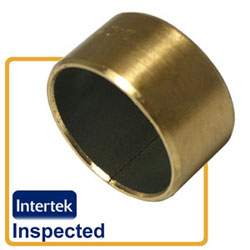
In practical terms, the JF-series bimetal bushings from Ahcell — manufactured with a low-carbon steel shell and sintered CuSn6.5P0.1 or CuPb24Sn4 alloy lining — are engineered for exactly these high-load, oscillating-motion scenarios. Unlike wrapped bronze bearings (FB090/FB092), which require regular grease replenishment, the JF bimetal design permits extended lubrication intervals thanks to the alloy layer's oil-retaining porosity. For hydraulic cylinder and steering gear applications where shock loading is frequent, the bimetal construction absorbs impact energy that would cause fatigue cracking in solid bronze alternatives.
Capacity investments confirm the demand outlook. Menon Bearings, a major Indian supplier, is scaling bi-metal production from 4.86 million units in FY25 to 5.50 million units in FY26 — a 13% increase — with 38 new parts under qualification for a key OEM customer. The company reported consolidated revenue of INR 2.11 billion for the first nine months of FY26, up 18.5% year-on-year, and expects incremental revenue of INR 500–600 million from expanded capacity. Globally, GGB leads the competitive landscape with estimated annual revenue of approximately USD 300 million in the bimetal segment. As lead-free regulations tighten across Europe and North America, manufacturers that have already qualified Pb-free alloy systems stand to capture disproportionate share of the projected growth.