

DX POM Bearings for Construction Machinery Pivot Joints
Construction machinery pivot joints — the connections between the boom, arm, bucket, and chassis on excavators, loaders, and bulldozers — operate under extreme conditions. These joints experience heavy radial loads at slow oscillation speeds, frequent exposure to mud, dust, and water, and often operate in locations that make daily greasing impractical. DX POM coated bushings, also known as SF-2 type boundary-lubricating bearings, have been engineered specifically to meet these demands. Their three-layer composite structure — steel backing, sintered bronze intermediate layer, and POM (polyoxymethylene) overlay with pre-lubricated indents — provides a combination of load capacity, wear resistance, and self-lubrication that is well matched to the rigors of construction equipment.
Three-Layer Composite Construction
The DX bushing consists of three functional layers. The steel backing, typically low-carbon steel (SPCC or DC01) in thicknesses from 0.4 to 2.2 mm, provides the mechanical strength required to withstand static loads up to 250 N/mm2 and dynamic loads of 140 N/mm2. The intermediate layer is a porous bronze sintered structure approximately 0.2–0.3 mm thick, which bonds the POM overlay to the steel backing while also conducting heat away from the sliding interface. The working surface is a 0.3–0.5 mm layer of modified POM with circular or diamond-shaped indentations for grease retention.
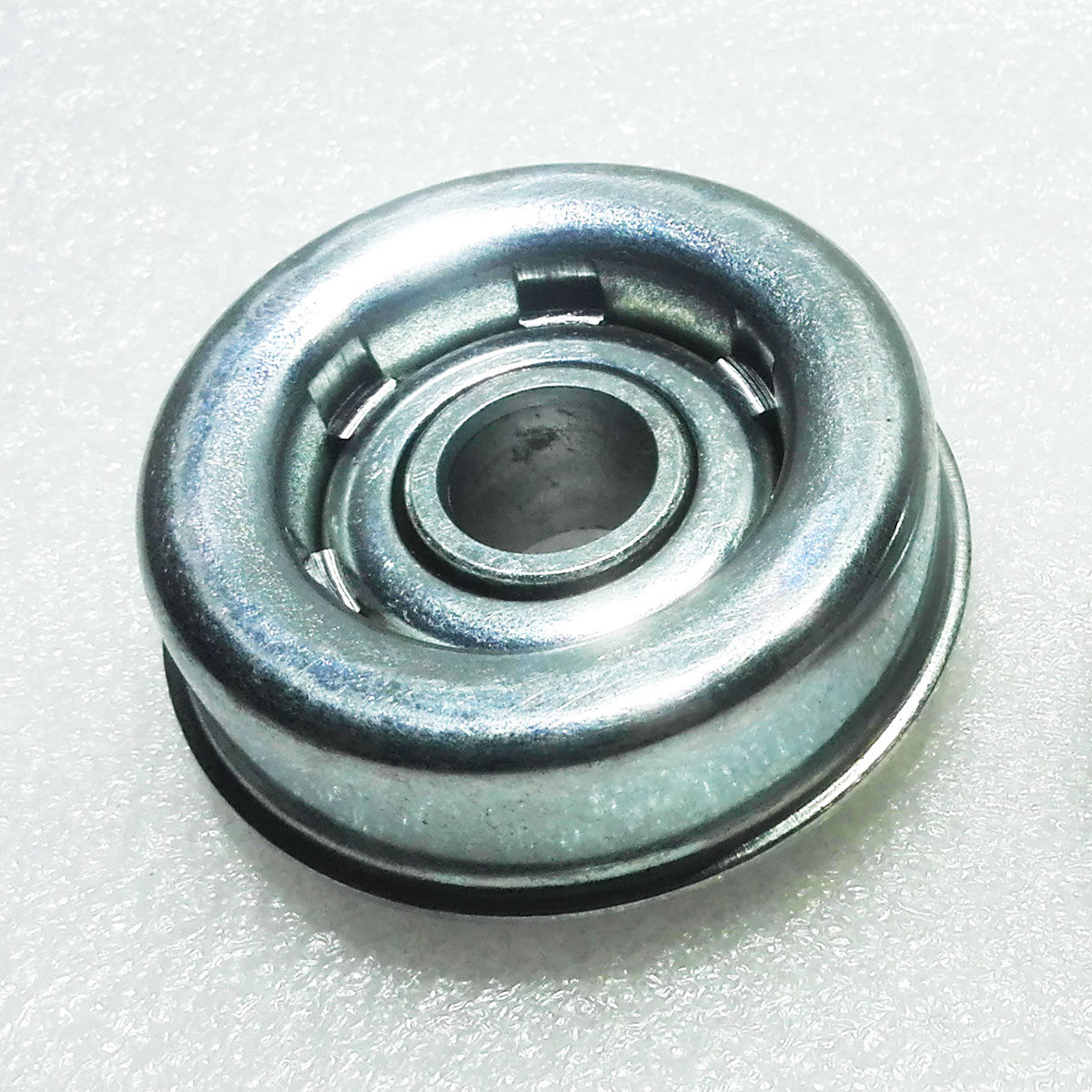
The POM material itself is compounded with additives such as MoS2 and other solid lubricants to reduce the coefficient of friction to 0.05–0.20 under boundary lubrication conditions. The indentations — typically 1–3 mm in diameter — are filled with grease during assembly, providing an immediate lubricant reserve. As the joint oscillates, grease is drawn from the pockets and smeared across the POM surface, maintaining a low-friction interface even when external re-greasing intervals are extended.
Temperature Range and Environmental Resistance
DX bearings are rated for continuous operation from −40°C to +120°C. This covers all common construction machinery operating environments, from arctic mining operations to tropical quarry sites. The POM overlay does not absorb water, which means the bearing dimensions remain stable in wet conditions — a significant advantage over nylon or other hygroscopic polymer bearings that can swell and bind in humid environments.
The sintered bronze intermediate layer also contributes to damping characteristics. In pivot joints subject to impact loads — such as when an excavator bucket strikes rock or concrete — the bronze layer absorbs and dissipates energy, reducing peak stresses transmitted to the pin and housing. This damping capability extends the service life of both the bushing and the surrounding structural components.
Performance Under Low-Speed Heavy-Load Oscillation
Pivot joints in excavator booms, loader arms, and bulldozer blade linkages exhibit slow oscillating motion — typically less than 10 cycles per minute — with angular travel of 30–120 degrees. Under these conditions, a full hydrodynamic oil film does not develop. Instead, the bearing operates in the boundary or mixed lubrication regime, where surface-to-surface contact occurs periodically. This is where the DX bearing's POM overlay performs best.
The POM surface has low shear strength, meaning that when asperities contact, the softer POM material yields preferentially, preventing damage to the mating steel pin. This is the tribological principle of embedability and conformability in action — the bearing surface adapts to the pin geometry while absorbing any hard particles that enter the joint. The PV limit for DX bearings under grease lubrication is 2.3 N/mm2·m/s, with a maximum sliding speed of 2.5 m/s. For pivot joints where speeds rarely exceed 0.1 m/s, the load capacity is effectively limited only by the bearing's static and dynamic ratings.
Applications in Excavator and Loader Linkages
DX bushings are commonly installed at the boom pivot (where the boom attaches to the chassis), the arm pivot (boom-to-stick connection), and the bucket pivot (stick-to-bucket connection). At each location, the bushing must support loads that vary continuously as the machine lifts, swings, and digs. The boom pivot sees the highest bending moments, often requiring bushings with ID in the 60–120 mm range. The bucket pivot experiences the most severe shock loads due to direct contact with rock and debris.
The initial pre-lubrication applied during assembly fills the POM indents with grease that lasts for the first 200–500 operating hours. After this period, the grease depletes and the bearing relies on the solid lubricant additives within the POM matrix. A single re-greasing at this point restores the indent reservoirs and extends service life significantly. Many construction equipment OEMs specify DX bushings as the standard pivot joint bearing in their service manuals.
Comparison with Bronze-Only and PTFE-Lined Alternatives
Compared to solid bronze or wrapped bronze bushings (FB090/FB092), DX bushings offer a lower coefficient of friction at startup, which reduces pin wear and joint fretting. The POM overlay also provides better edge-load tolerance — when the housing bore is slightly out of round or the pin is misaligned, the polymer layer deforms locally rather than transferring full load to a single contact point.
Against PTFE-lined bearings (DU type), DX bushings offer higher static load capacity (250 N/mm2 vs 140 N/mm2 for many DU variants) and better resistance to shock loads. The POM layer is tougher and less prone to cold flow under sustained heavy loads, making DX the preferred choice for construction machinery pivot joints where static loads dominate and oscillation speeds are low.
DX bushings conform to ISO 3547 dimensional standards and are available in sleeve, flanged, and thrust washer configurations. For construction machinery applications, the flanged variant is common because the flange provides axial location, preventing the bushing from walking out of the housing during operation. Standard metric sizes cover IDs from 10 mm to 300 mm, accommodating the full range of excavator and loader pivot joint requirements.
- Pre:No Information
- Next:FB090 Wrapped Bronze Bearings for Hydraulic Cylinders 2026/8/10