

Slide Bearings Beat Ball Guides in Dusty Plants 2026
Recirculating ball bearing guides have been the default for linear motion design for decades, but that assumption faces increasing scrutiny. According to igus, self-lubricating sliding systems outperform recirculating ball guides in contaminated, dusty, or washdown environments where grease becomes a liability rather than an asset. In facilities running woodworking, packaging, or metalworking equipment, contaminated grease forms an abrasive paste that accelerates wear on ball bearing raceways. The KEMARO K900 autonomous cleaning robot adopted igus drylin T linear guides specifically to avoid dust accumulation on lubricated surfaces, resulting in a quieter, lighter system requiring less maintenance.
The engineering argument is straightforward. Recirculating ball guides depend on steel balls circulating between carriage and rail, which demands consistent lubrication, tight tolerances, and clean operating conditions. When any of those conditions degrade, friction performance drops fast. Sliding bearings operate with the carriage moving directly on the rail surface. No rolling elements means no ball fatigue, no recirculation noise, and no grease circuit to maintain. A 2026 technical analysis by Linear Motion Tips confirms that environmental factors remain the hardest parameter to quantify in bearing selection. Unlike load or speed, there are no standard calculation tools for contamination exposure. igus notes that engineers who reduce the sliding versus rolling question to friction alone are asking the wrong question. Load capacity, noise, weight, contamination resistance, and maintenance requirements often carry equal or greater weight in real applications.
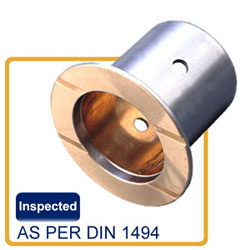
For graphite-plugged bronze guide plates, the self-lubricating mechanism works through solid graphite plugs pressed into the bronze base at high pressure. As the shaft or slide moves, graphite transfers to the mating surface, forming a protective film that prevents metal-to-metal contact. According to BearingFace, self-lubricating bronze plates achieve tensile strength between 500 and 700 MPa with hardness of HB 180 to 220. The graphite-plugged variants provide continuous maintenance-free lubrication and are ideal for hard-to-reach areas. Bronzebush.com confirms these bearings excel in heavy-load, low-speed, and intermittent-motion conditions where oil film formation is difficult. Common bronze alloys include C95400 aluminum bronze for marine applications, C93200 bearing bronze for general industrial use, and C86300 manganese bronze for extreme loads.
The GSB series from Ahcell, manufactured from CuZn25Al6Fe3Mn3 bronze with hardness of 200 HB minimum, handles static loads up to 100 N/mm2 with a PV limit of 1.65 N/mm2.m/s. Temperature range spans -50 to +300 degrees C. The 14 variants include L-shaped guides (SGLXS, SGLX, SOL), T-shaped slide bearings (TGLWN), rectangular pads (SGLDW, SOLP), and wear plates (SESW, SP, TLP) in configurations that match NAAMS standards for automotive stamping die applications.
PV calculations remain essential for sizing. Cast bronze C93200 carries a maximum PV of 75,000 psi-sfpm per Bronze Headquarters data. C86300 manganese bronze reaches 150,000 psi-sfpm. C95400 aluminum bronze handles 125,000 psi-sfpm with superior corrosion resistance. When selecting between a PTFE-lined DU bushing and a graphite-plugged JDB bearing for a specific linear guide, evaluate contamination level, maintenance access, temperature, and load profile together. The right choice depends on operating conditions, not datasheet numbers alone.
- Pre:Graphite Bronze Bearings Solve Marine Lube Problems 2026 2026/5/12
- Next:Bimetal Bushing Selection: SAE 792 vs SAE 797 Guide 2026 2026/5/10