

Sintered Bronze Bearings: $5.1B Market by 2033 (2026)
The global sintered sliding bearings market, valued at USD 3.2 billion in 2024, is projected to reach USD 5.1 billion by 2033 at a CAGR of 5.5%, according to Verified Market Reports. A parallel study from Data Insights Market sizes the broader sintered bronze components market at $6.041 billion in 2025, with powder metallurgy advances in alloy composition and dimensional accuracy cited as primary growth factors. Bearing bronze demand specifically, tracked by Reports and Data, grows even faster at 7.5% CAGR, moving from $1.2 billion (2024) toward $2.5 billion by 2034.
Under the SAE 841 specification (ASTM B438), oil-impregnated sintered bronze bearings maintain a minimum porosity of 18% by volume, with a chemical composition of Cu 87.5-90.5% and Sn 9.5-10.5%. The material delivers a limiting PV value of 50,000 psi-ft/min and an ultimate tensile strength of 14,000 psi. Operating temperature ranges from -12°C to 104°C. Dimensional compliance falls under ISO 3547 for wrapped bushes and DIN 1494 for metric sizing. GGB, GKN, and Senju Metal Industry are among the established producers; newer entrants like AMES and Technymon are pushing finer pore distributions and higher oil retention rates to extend relubrication intervals.
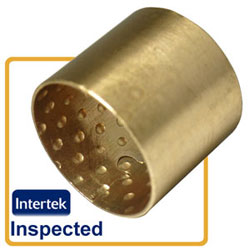
In hydraulic cylinder and pump applications, sintered bronze competes directly with wrapped bronze bearings like the FB090 (CuSn8P, DIN 1494 compliant, diamond oil groove pattern). For moderate loads where periodic relubrication is possible, the FB090 offers better load capacity at lower cost. Where maintenance access is limited, the oil-impregnated sintered type provides adequate self-lubrication up to its PV limit. For higher temperatures or heavier loads beyond what sintered bronze can sustain, graphite-plugged JDB cast bronze bearings become the practical upgrade, handling continuous operation at 300-400°C without external lubrication. The choice between these three types comes down to load, speed, temperature, and whether the application permits re-oiling.
EV drivetrain demand is now the strongest growth vector for sintered bearings. Global EV sales reached 17.1 million units in 2025 per IEA data, and manufacturers need lightweight, self-lubricating bushings for electric motor shafts and reduction gear supports. Powder metallurgy also benefits from near-net-shape production, which reduces material waste by up to 95% compared to machining from bar stock, an advantage that matters as copper and tin prices stay volatile.
- Pre:Wrapped Bronze Bushings Gain Share in Hydraulic Cylinders 2026/5/4
- Next:ISO 3547 Wrapped Bushing Standards Update 2026 2026/5/2