

Wrapped Bronze Bushings Cut Hydraulic Cylinder Downtime 2026
Fluid contamination drives up to 80% of hydraulic system failures, according to the National Fluid Power Association (NFPA). The bushings inside those cylinders take the brunt of the damage: scored rods, uneven wear, and seized joints all trace back to one root cause. The bearing surface can't handle what the operating environment throws at it. Tin bronze (CuSn8) wrapped bushings, manufactured to ISO 3547 and DIN 1494 standards, remain one of the most common choices for hydraulic cylinder pin joints in construction, mining, and agricultural equipment. Their diamond-shaped oil indentations or through-wall oil holes store grease that feeds the contact surface during operation, extending service intervals compared to plain-sleeve designs.
According to Bowman Bearing Technologies, CuSn8 rolled phosphor bronze delivers a static load rating of 120 N/mm² and a PV limit of 2.8 N/mm²·m/s under lubricated conditions. The alloy composition (Cu balance, Sn 8.5%, P 0.2%) yields a hardness of 90–120 HB and a tensile strength of at least 450 N/mm². These numbers matter in hydraulic cylinders because pin joints experience oscillating loads at low speed. The PV value stays within limits, but the static load can spike sharply during dig cycles. FB090-type bushings with diamond oil pockets handle this well. FB092 variants with through-wall oil holes offer a different advantage: direct lubrication paths through the bushing wall make re-greasing more effective in heavy-duty pivots like excavator boom joints.
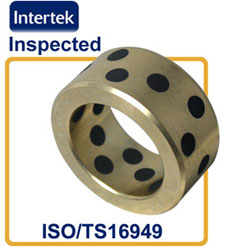
A practical point from field mechanics: when a pin-bushing pair runs without adequate grease, the bushing fails first. Heat builds up, the bronze galls against the hardened steel pin, and the joint seizes. In dirty environments, both surfaces wear simultaneously as abrasive particles mix with the remaining lubricant, forming a grinding paste. That is why the FB090 and FB092 designs, with their built-in grease reservoirs, outperform plain bronze sleeves in real-world conditions. The indentations trap fresh grease and release it under pressure as the pin rotates. For applications where re-greasing is impractical, graphite-plugged bronze (JDB type) provides an alternative. Solid graphite inserts create a transfer film on the pin surface, supporting static loads up to 250 N/mm² without any external lubrication. PTFE-lined composite bushings (DU type) offer another maintenance-free path, with friction coefficients as low as 0.02, though they are more vulnerable to extreme shock loads than solid bronze.
The 60% rule applies to cylinder repairs: if the repair cost exceeds 60% of a new cylinder, replace it. Bushing selection follows a similar logic. Standard CuSn8 wrapped bronze works when you have a solid maintenance schedule and easy grease access. Graphite-plugged bronze justifies its higher upfront cost when the joint is hard to reach or operates in contamination. PTFE composite makes sense for continuous rotation at moderate loads. The key is matching the bearing type to the actual operating conditions, not just the load rating on a spec sheet. Unplanned downtime costs manufacturers an average of $125,000 per hour, according to a 2023 ABB survey, so choosing the right bushing the first time pays for itself fast.
- Pre:Graphite Bronze Bearings Fix 80% Lube Failure Problems 2026 2026/5/16
- Next:PEEK vs PTFE Linings: Evonik Fluorine-Free Bearing 2026 2026/5/14