

PEEK vs PTFE Linings: Evonik Fluorine-Free Bearing 2026
In April 2026, Evonik launched VESTAKEEP® Easy Slide 2, a tribological PEEK (polyether ether ketone) material designed specifically for slide bearings operating under high temperature and pressure. The material is produced without intentionally added fluoropolymers, including PTFE, which has been the default low-friction liner in composite bearings for decades. According to Philipp Kilian, R&D Program Manager for PEEK at Evonik, comprehensive test data shows the material has "superior tribological properties, especially in resistance to high temperatures, pressure and velocity" compared to other polymer-based slide bearing materials. Evonik reports strong results in both dry-run and lubricated conditions across industrial, medical, and robotics applications.
The move away from PTFE linings is technically significant. PTFE offers an extremely low coefficient of friction (0.03–0.05) and chemical inertness that make it the standard overlay in three-layer composite bushings like the DU series, which delivers static load capacity up to 140 N/mm² and PV values of 3.6 N/mm²·m/s per ISO 3547. However, PTFE has real limitations: low tensile strength (25–35 MPa), high thermal expansion (14 × 10⁻⁵/K), and poor creep resistance under sustained load. PEEK addresses these directly with tensile strength of 90–100 MPa, flexural modulus around 3,900 MPa (versus ~495 MPa for PTFE), and roughly one-third the thermal expansion coefficient. The trade-off is friction: PEEK registers 0.35–0.45 versus PTFE's near-zero drag, and PEEK costs roughly 10× more per kilogram.
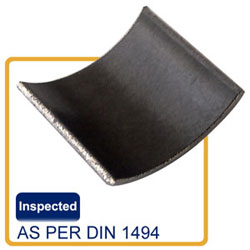
Real-world testing adds nuance. Michell Bearings compared PTFE and PEEK thrust pads in vertical pump applications and found that PTFE pads outperformed PEEK despite PEEK's higher strength and stiffness. PTFE's insulating property reduces thermal crowning, maintaining a flatter operating surface under load, and PTFE tolerates rotation reversals with offset pivots—a common requirement in vertical pump installations where PEEK lacks published data. For sliding bearing selection in 2026, the picture is now application-specific: PTFE-lined DU bushings remain the pragmatic choice for dry friction, chemical exposure, and cost-sensitive designs operating within -195 to +280°C, while PEEK-based bearings like Evonik's new formulation target high-load, high-velocity, and dimensionally critical installations where creep resistance and tight tolerances matter more than absolute friction coefficient.
Evonik's VESTAKEEP® Easy Slide 2 also benefits from injection moldability, a processing advantage PTFE cannot match due to its extreme melt viscosity. As Christopher Studte, Head of Industrial PEEK at Evonik, noted, this gives "increased cost-efficiency, especially when scaling up to produce large quantities." For engineers specifying bushings under DIN 1494 or ISO 3547, the PEEK-versus-PTFE decision now depends less on theory and more on specific duty parameters: load direction, speed, temperature cycling, chemical exposure, and whether reverse rotation tolerance is required.
- Pre:Wrapped Bronze Bushings Cut Hydraulic Cylinder Downtime 2026 2026/5/15
- Next:Graphite Bronze Guide Bushings Cut Mold Downtime 2026 2026/5/13