

JDB Graphite Bronze Bushings Cut Cement Plant Downtime
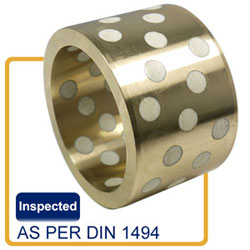
Dust, not load, is the first cause of bushing failure in cement plants, and graphite-plugged JDB bronze bushings are engineered to remove that failure mode. According to Jiaxing Bushing Manufacturing (JBM), a graphite plugged bronze bushing carries a PV limit of 1.65 N/mm²·m/s and a maximum static load of 100-120 N/mm², with dry friction of 0.08-0.18 and maintenance-free operation from -40°C to +400°C. That rating matches the duty of kiln support rollers, packing machine shafts, crushers and conveyors, where re-lubrication is impractical and grease contamination is constant.
Why cement plants lose bushings
Cement dust is abrasive and fine enough to enter almost any housing. Bronzeoilless, a custom bronze parts manufacturer, identifies dust contamination as a leading cause of premature bearing failure: grease-lubricated bushings collect grit, the lubricant degrades, and wear accelerates. Graphite-embedded bronze sidesteps the problem because solid lubricant plugs cannot wash out or pick up dirt.
The cost of failure is steep. Bearingface reports that a single trunnion bearing failure on a rotary kiln can stop clinker production at a cost upwards of $50,000 per day. Kilns sit on a 3-5% incline, so support roller bushings carry radial dead weight and continuous axial thrust at the same time. Bearingface supplies flanged and split bushings for those stations, plus a JDB-650 graphite-inlaid bushing rated for high-heat zones up to 300°C.
Where JDB bushings fit
- Kiln support rollers: thick-walled radial sleeves and flanged bushings, often 250 mm ID, handling trunnion loads up to 150 kN.
- Rotary cement packers: the central hollow shaft turns at only 0.45-4.5 rpm while carrying the full drum weight, a classic slow-speed high-load case.
- Impeller and discharge shafts: 700-1400 rpm with severe dust ingress, where graphite plugs keep the shaft running even when dust packs the housing.
- Conveyors and crushers: intermittent, shock-loaded pivots with oiling points that are hard to reach.
JDB bushings from Ahcell use a high-strength cast bronze base, CuZn25Al6Fe3Mn3, with solid graphite columns covering 20-30% of the surface. Graphite transfers to the shaft as a self-replenishing film, so the tribological system keeps working under boundary lubrication when a hydrodynamic film cannot form. Static capacity is 100 N/mm² with a dry speed limit of 0.5 m/s, and the bronze base adds conformability that helps the bushing seat against a slightly misaligned shaft.
How to select a bushing for cement equipment?
Match the alloy to the station. Where bushings can be greased regularly, plain ZCuSn5Pb5Zn5 (5-5-5 tin bronze) offers the best balance of cost and wear resistance, while ZCuSn10Pb1 handles bearing pressures up to about 20 MPa. Where lubrication access is poor or dust is heavy, switch to a graphite-plugged JDB type, which meets ISO 4379 and DIN 1850 and needs no oil or grease at all.
Ahcell manufactures JDB graphite bronze bushings in sleeve, flanged, thrust washer and custom geometries for cement plants. Swapping a grease-lubricated bronze bushing for a plugged type removes one lubrication task from the maintenance schedule, and removes the risk that a missed grease round turns into a $50,000 kiln stop.
- Pre:No Information
- Next:Self-Lubricating Bearings for Pumps and Compressors 2026 2026/11/9