

POM vs PTFE Bushing Selection for Heavy Equipment 2026
Excavator bushings at boom joints, bucket pins, and hydraulic cylinder eyes face some of the harshest conditions on any job site. A 2026 study published on ResearchGate examined pin-bushing bearings in heavy-duty construction machinery and found that those operating in severe environments with contaminated lubricant suffer accelerated wear. Italian manufacturer SIBO notes that these components function as sacrificial wear parts, absorbing shock and vibration while protecting expensive boom and arm assemblies from direct metal-on-metal damage.
The choice between POM (DX-type) and PTFE (DU-type) composite bushings depends on operating conditions, not cost. According to specification data published by ISK Bearings in May 2026, DX POM bushings achieve a PV limit of 10 MPa·m/s under oil lubrication, nearly three times the DU PTFE dry-running limit of 3.6 MPa·m/s. However, DU PTFE handles dry operation at temperatures from -195°C to +270°C, while DX POM is limited to -20°C to +100°C. JBM Engineering reports that POM composite bushings support static loads up to 250 N/mm² with a friction coefficient between 0.05 and 0.20 under greased conditions. One often-overlooked difference: DX POM has a linear thermal expansion coefficient of 5.1×10⁻⁵ per °C versus DU PTFE's 27×10⁻⁵, so POM-lined bushings hold dimensional stability much better under temperature swings.
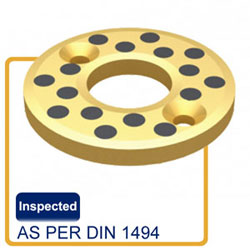
For excavator boom pivots, loader bucket pins, and crane slewing rings, DX POM bushings offer practical advantages that PTFE cannot match. Their integrated grease pockets store lubricant and release it during operation, extending re-lubrication intervals by up to three times compared to solid bronze bushings in hydraulic cylinder service, according to test data from MYWAY. The same pockets trap wear particles and debris, critical on construction sites where dust infiltration is constant. POM's inherent damping absorbs impact loads that would disrupt PTFE's delicate transfer film. Unlike PTFE, POM lining can be machined after press-fit installation, allowing engineers to achieve precise shaft clearances without special tooling. The Ahcell DX series (SF-2 type) follows this three-layer architecture: low-carbon steel backing, sintered bronze interlayer, and modified POM overlay with pre-formed grease indentations, rated for static loads of 140 N/mm² and PV values of 2.3 N/mm²·m/s under boundary lubrication per ISO 3547.
Both DX and DU bushings comply with DIN 1494 and ISO 3547 standards, and shaft requirements are the same for both types: surface roughness Ra 0.4–0.8 μm, hardness 180–600 HB, tolerance h7 to h8. The deciding factor is lubrication access. Where grease fittings are available and operating temperatures stay below 100°C, DX POM delivers higher PV capacity, longer service intervals, and better shock tolerance in contaminated environments. Where re-lubrication is impractical or temperatures exceed the POM range, DU PTFE's dry-running capability makes it the correct engineering choice.
- Pre:PTFE Bushings Cut Contamination in Food Processing 2026 2026/5/21
- Next:PTFE Dry Bushings Outperform Grease in High-Load Pivots 2026 2026/5/19