

PTFE Lined Bushings Face 2026 PFAS Regulatory Pressure as Market Heads Toward $3.27 Billion
The global polytetrafluoroethylene (PTFE) market, valued at USD 1.95 billion in 2025, is projected to reach USD 3.27 billion by 2034 at a CAGR of 5.9%, according to Fortune Business Insights. The industrial and machinery segment — which includes PTFE-lined composite bushings used in bearings, gears, and seals — accounted for the largest share at 36.10% in 2026. Yet this growth trajectory now faces a significant headwind: the accelerating regulatory crackdown on per- and polyfluoroalkyl substances (PFAS) that could reshape PTFE liner formulation across the bearing industry.
Under ISO 3547 and DIN 1494, PTFE-lined wrapped bushes are classified as multilayer composite bearings consisting of four functional layers: a PTFE-based sliding layer (10–50 µm, typically filled with graphite or MoS₂), a sintered bronze interlayer (CuSn8/CuSn10, 0.15–0.35 mm), a low-carbon steel backing (DC04/SPCC), and an outer tin or zinc plating for corrosion protection. Critical performance parameters include a maximum PV value of 2.8 N/mm²·m/s under dry operation, static load capacity up to 250 N/mm², and an operating temperature range of −195°C to +260°C. The friction coefficient in dry conditions typically falls between 0.08 and 0.20 in steady state — values that make PTFE-lined bushings irreplaceable in applications where external lubrication is impractical. However, below 15 µm PTFE thickness, debris embedability suffers; above 40 µm, creep becomes a concern. These trade-offs leave engineers with a narrow design window that becomes even tighter when regulatory mandates force material substitutions.
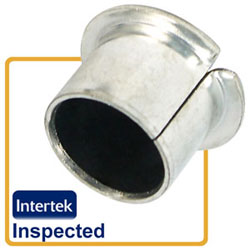
The regulatory landscape shifted noticeably in early 2026. The U.S. EPA intends to finalize a rule designating nine PFAS compounds to the RCRA Hazardous Constituents list in April 2026, while 18 states have enacted PFAS product restrictions ranging from labeling requirements to outright bans. Connecticut now requires PFAS labeling for industrial products effective July 1, 2026, with an unconditional ban following in 2028. For bearing manufacturers, this means the traditional PTFE formulation used in DU-type (SF-1) self-lubricating bushings must be re-engineered. GGB has already responded with its HSG fiber-reinforced composite PTFE bearings for high-load applications, while CCTY Bearing introduced PTFE fabric-lined FSA bushings with woven PTFE fibers for heavy-load, low-speed use cases such as aerial work platforms. Ahcell's DU series PTFE-lined bushings, featuring the three-layer steel-bronze-PTFE architecture compliant with ISO 3547, are available in lead-free formulations to meet emerging regulatory demands without sacrificing the low friction coefficients and wide temperature tolerance that define dry-running bearing performance.
With the automotive segment holding an 18% share of the PTFE market and Asia Pacific commanding 56% of global demand (led by China at USD 0.79 billion in 2026), bearing suppliers face both opportunity and urgency. The micronized PTFE market alone is projected to grow from USD 0.30 billion in 2025 to USD 0.39 billion by 2030 at a CAGR of 5.2%, per Yahoo Finance data. As EPA's PFAS Strategic Roadmap gains enforcement teeth and state-level product bans multiply, the companies that transition fastest to PFAS-free and lead-free PTFE alternatives — while maintaining PV limits above 2.5 N/mm²·m/s — will define the next generation of maintenance-free sliding bearings.